WHAT HAPPENED IN ECUADOR??
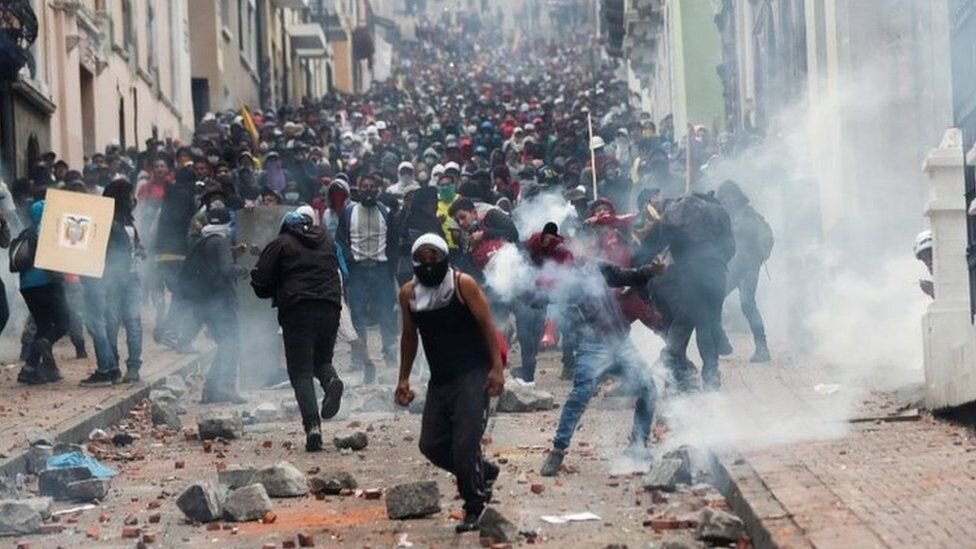
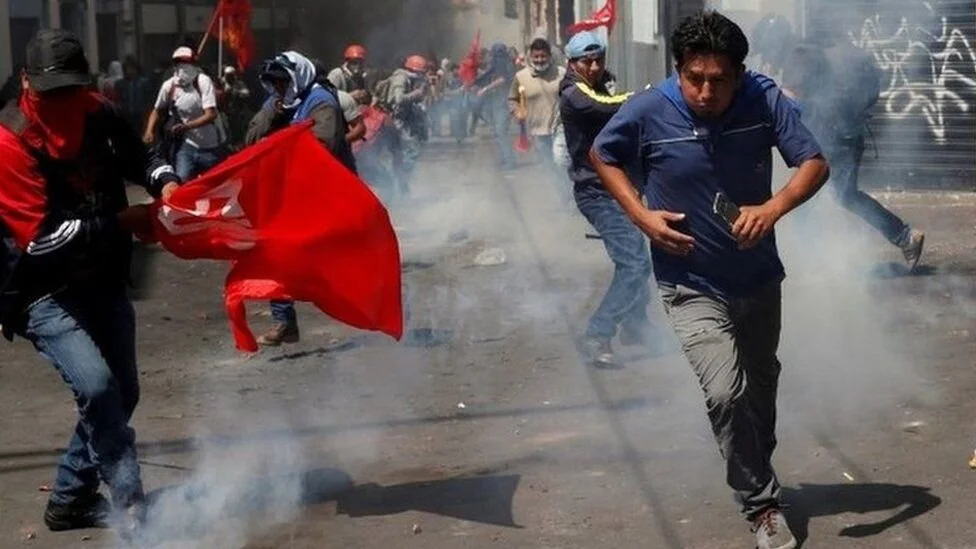
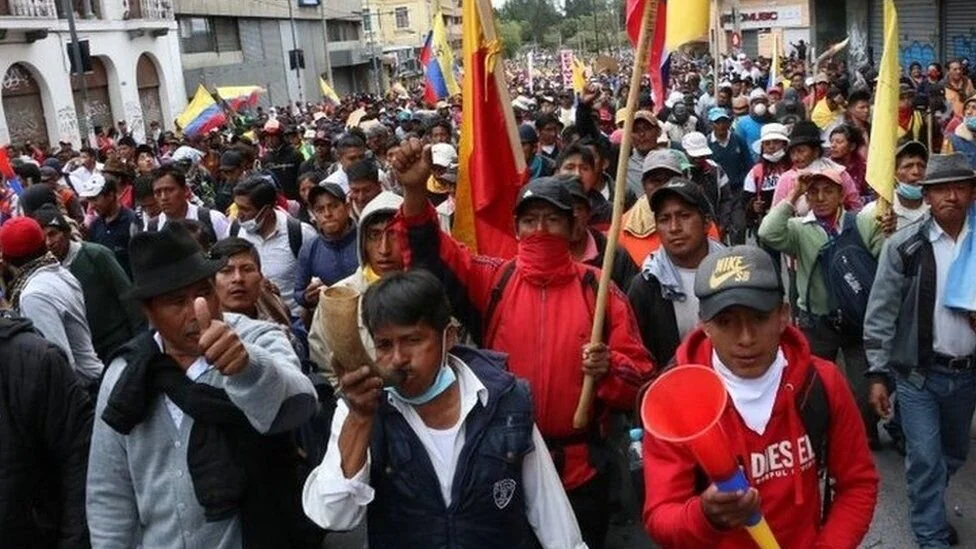
From October 3-13 nation-wide protest took place in Ecuador. There were a reported 1,200 arrest, 1,300 injuries and 8 deaths attributed to the 11 days of protest. There are many factors at play here in the politics of Ecuador and no one really knows every fact and the motives of each person, so there is a bit of opinion mixed in with fact here in my explanation but hopefully it helps give a better picture of what all has taken place and what is happening now.
THE PROTEST AND HOW IT STARTED:
On Oct 1st, Ecuador’s president, Lenin Moreno, announced a number of economic reforms aimed to help the nation recover financially. Many years of corruption and socialist rule has left the nation with a crippling financial burden. The main measure introduced was the elimination of a 40 year old fuel subsidy which has kept gas prices incredibly low, but its elimination doubled the price of Diesel overnight and increased regular low octane gas by over 50%.
This sudden rise in fuel prices initially sparked a national 2-day strike by the taxi drivers and bus drivers unions, arguing they would need fare adjustments to accommodate the higher fuel cost and make a profit. Just when an agreement with the these 2 groups looked like it would end the protest, many other protestors, led by the nations indigenous community, began to descend on Quito and many of the other major cities in Ecuador. Most of these were farmers who would also be greatly affected by higher fuel prices. Ecuador’s indigenous communities are known for their protest that have ousted 3 different presidents in the past.
The protests grew larger and larger over the next 9 days, with the indigenous leaders saying they would continue their protest until the fuel subsidy was reinstated. President Moreno refused, saying it was vital for the economic survival of the nation. President Moreno was forced to flee to the coastal city of Guayaquil out of fear for his safety. He also declared a national State of Emergency, granting him power to mobilize the military in the streets.
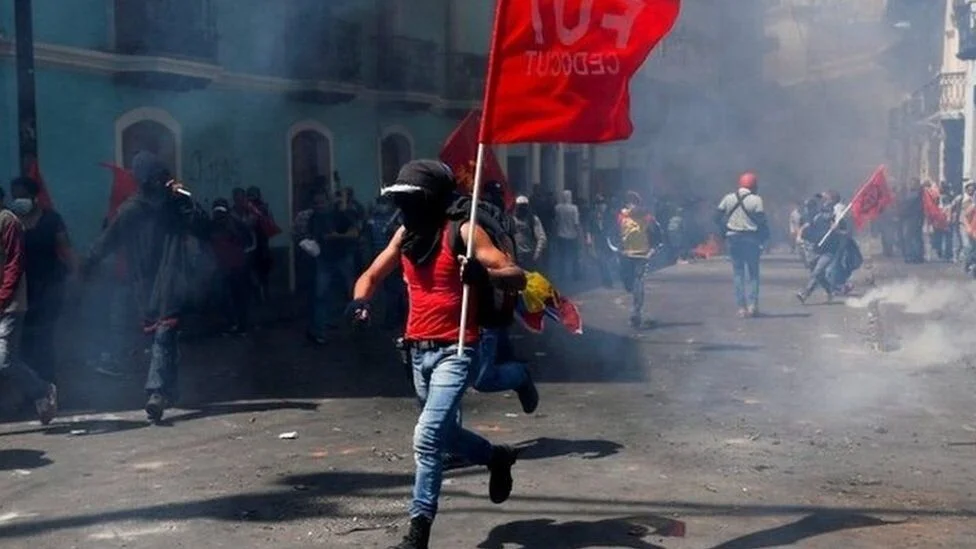
Protestors were met with resistance by physical force and with tear gas from police and military. Many protested peacefully, but many did not. Some police and military attempted to hold back protestors without inciting violence, but that was not always the case either. In some cases Police and Military were outnumbered and outmatched and were forced to retreat. The protest shut down the central part of Quito for over a week and major damage was done to streets and buildings. This central part of Quito is a Unesco World Heritage Site, and has been one of the best kept colonial city centers in South America.
Apart from the indigenous community and those who joined with them, was another group that was active during the 11 days of protest. They acted separately from the other protestors and seemed to seize on the opportunity to cause harm. This group’s actions seemed to follow a pattern of directly and indirectly taking revenge on enemies of Ecuador’s former president, Rafael Correa. Whether or not he is responsible for organizing their actions remains to be proven. The following are some of the actions of this group that took place during the 11 days of protest:
Attacked the building of one of the city’s major television stations. Setting two busses on fire, breaking out windows, and briefly taking the staff hostage before being run out by the military. (This station has historically been in opposition of former president Correa and his actions/policies)
Attacked the local newspaper’s building (also critical of Correa when not being censored by the government)
Burned down the national Comptroller’s office where evidence against former president Correa was being held for his trial. (Correa’s sentencing was set to take place in the days that the protest took place)
Attacked cars at random on city streets (widely reported and Correa loyalist were caught on camera doing so)
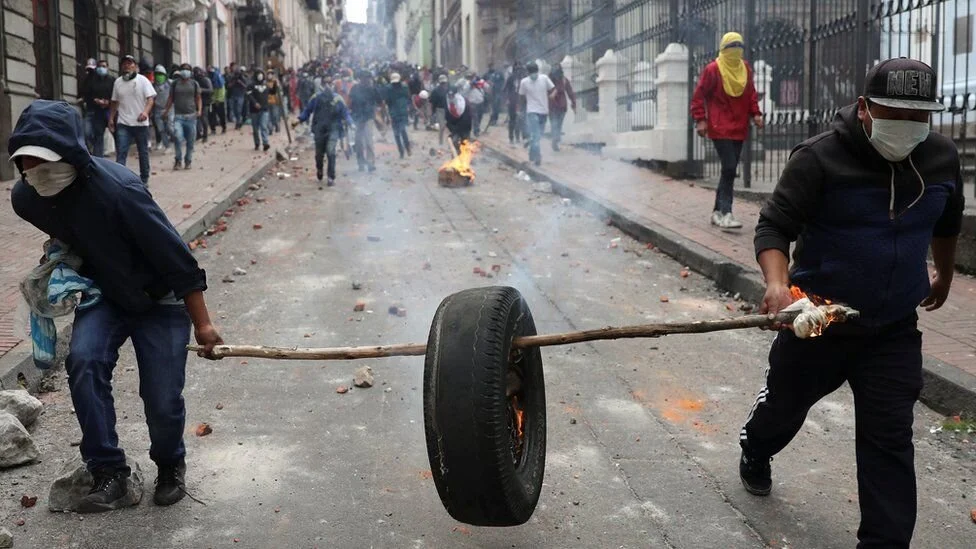
Blocked a number of major roads throughout the city for days and attacked cars that attempted to pass
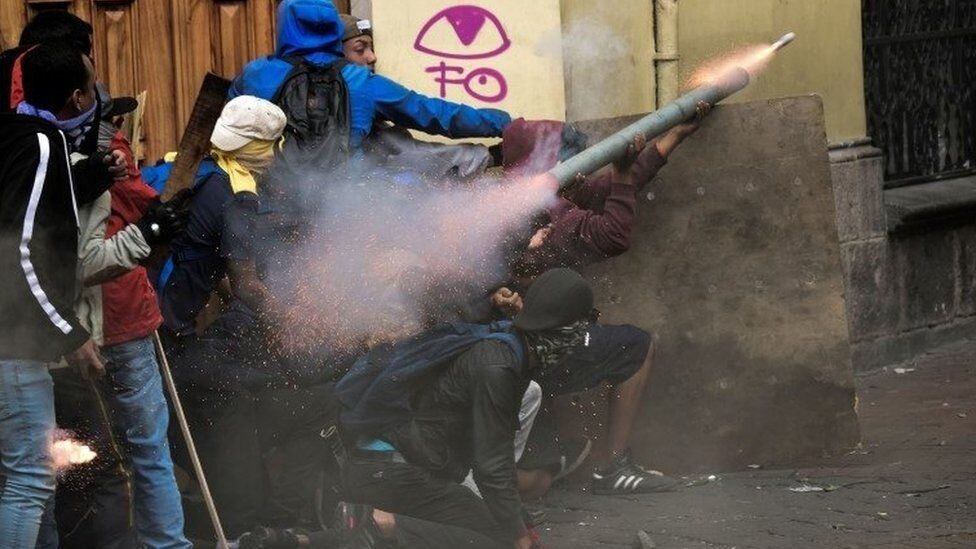
Infiltrated other groups of protestors, attacking police with homemade firebombs to incite violence in the midst of otherwise peaceful protest
There has been mounting evidence that many in this group were loyalist of former president Rafael Correa. Others have been identified as homeless or in desperate need who took payments of $20/day to participate, which is more than they would receive from a typical paycheck. Correa is currently in exile in Belgium due to a warrant for his arrest here in Ecuador and has been convicted on various counts of corruption during his time in office. He is strong allies with the president of Venezuela, Nicolas Maduro, the FARC rebel group of Columbia and the Latin Kings gang, all who are believed to have played a part in the violence that took place here in Ecuador. If you are not aware of the current situation in Venezuela or the actions of the FARC rebel group, I encourage you to do a quick Google search. Hundreds of thousands of Venezuelan’s have taken refuge in Ecuador due to the humanitarian crisis in Venezuela and many are apart of our church community.
Video footage was found of a training facility here in Ecuador where those loyal to Correa were seen training with homemade weapons identical to those used by FARC rebels in Columbia. It would appear this group had been preparing for this very opportunity to cause chaos and destruction under the veil of an unrelated economic protest, all for revenge. There were even seventeen people arrested at the Quito Airport during the protest who, according to military officials, had maps of planned anti-government marches and information about President Moreno's personal security arrangements.
ECUADOR’S ECONOMIC SITUATION:
When President Moreno was elected in 2017, he was Correa’s former Vice President and chosen successor. Moreno praised Correa during his campaign and vowed to continue his socialist “People’s revolution.” But shortly after his election, Moreno turned his back on Correa. Moreno began to adopt much more centrist policies and champion the private sector, all a complete opposite of his campaign message as Correa’s chosen successor. No one knows exactly why this happened but Moreno and Correa have been in public opposition ever since, with the public generally unaware of where President Moreno stands on many issues.
One thing that is for certain is that Ecuador was left in a very dire economic situation after Correa’s presidency. President Moreno has taken some large loans this year, mainly a $4.2 billion loan from the International Monetary Fund, in an attempt to stimulate the country’s economy. Part of the agreement for this loan was that Moreno would enact reform to attempt to regain some ground economically. Which brought us to the cancelation of 40 years of fuel subsidies. It should also be noted that past governments have not only left us in a poor state economically, but also with a general distrust of government officials due to extensive corruption. So even when they seem to be doing something that would seem to make sense for the good of the nation, few trust their motives to actually be for the good of the people.
President Moreno explained that because gas prices were so low, smugglers were buying fuel and taking it across our boarders for profit and helping enable drug trade. Also, that it was costing the government somewhere around $1.6 billion a year to keep the prices so low. Even without the subsidy, Ecuador would still have some of the cheapest fuel prices in the world. And while the elimination of this fuel subsidy may seem logical for many, to those who live off of a lower income in Ecuador, the doubling of their gas prices overnight was very extreme and seemed crippling. Most of Moreno’s explanation for canceling the subsidy unfortunately did not come until after the subsidy was already gone and protest were in full force. It might have helped to try and explain more in advance.
THE END OF THE PROTEST:
On the 10th day of the protest, President Moreno agreed to consider changes to the cancelation of fuel subsidies, and the indigenous leaders agreed to meet with him. It wasn’t until the 11th day that the two sides were finally able to meet, in negotiations moderated by the United Nations. After only 4 hours of negotiations, The 2 sides came to an agreement that evening with the end result being the reinstatement of the fuel subsidies with a promise to come up with a different long-term solution for cost saving and debt reduction. Protest were immediately called off by the indigenous leaders and by the next morning, the streets had been emptied and clean-up began.
GOD AT WORK IN OUR FAMILY AND COMMUNITY:
For us personally, we had managed to stay away from any excitement for the most part. Except on the day before the agreement was made to end the protest, it was a Saturday and Debbie and I went to church to rehearse with the band for Sunday morning worship while Isa stayed with Debbie’s mom and dad. We had ventured out a couple of times during the week and Debbie’s dad had driven back and forth to the church every day without issue. The protest were mostly all taking place toward the central part of the city and not close to us so we felt fine about leaving, especially since it was the weekend and traffic should be light. While at the church Debbie received some news that the protestors were actually planning to increase their efforts and spread throughout the city right at that moment. We immediately left for home. While driving home we called Debbie’s mom and find out they had left to run an errand, not too far away from home, but with Isa. They were aware of the news and were attempting to head home. At that very moment, a group from the ill-intentioned group of protestors begin to close down some of the major roads of the city, including the one between them and home. Once they took control of the streets they would not let anyone access or cross them. Debbie’s mom, dad and our baby girl were trapped with no way to get home and no way of knowing how long the roads will be seized. Debbie and I arrive home safely but we can’t get to them and they can’t get to us. Debbie’s mom and dad, not sure what to do, stop to buy some water at a corner store. The area they were in, literally only had one way out - across the blocked road. On the other side is a giant mountain. There was nowhere to go. At the store where they stop, a very nice lady offers for them to take refuge in her home while they wait to see what happens. She allows them to cook lunch for Isa and even had toys for her to play with. About an hour later, as the protest begin to intensify, President Moreno calls for a city-wide curfew to begin immediately. The military will begin prohibiting anyone from being on the streets at all for the next 24hrs. Meanwhile, Debbie and I are at home and feel completely helpless and afraid our daughter might not make it home that night. We have no other choice but to pray and trust God to be with us and our family. We called Debbie’s dad and he says he will talk with the family and see if they are able to stay longer. In reality, he actually put everyone in the car and started driving. Just before this I had called my Dad to ask him to pray. He was at a meeting where he gathered a few others close by to pray with him. Another man had a word that God would open a way for them to get home to us. Debbie’s dad drove up to the protestors that were blocking the road and explained they needed to get their granddaughter home and asked if they would allow them to pass. After explaining where they were going he allow them to pass after advising them which route to take and to not go past the TV station that was about to be attacked. After allowing them to pass, they were not stopped again and there was not a single car on the road. They were home to us within 5 minutes. God is good.
Our church also had an amazing opportunity to help those in need during the protest. We were contacted by some people from the indigenous community early on saying that they needed a place to sleep. These were families from churches in the indigenous communities that we have regular contact with. They told us their community leaders had threatened their families and their property if they did not march with them to Quito to help protest. They were forced to come and help cook for the others and had nowhere to sleep. Some even were forced to bring their small children. The first night that we allowed them to take refuge in one of the church’s buildings, there were 200 of them. The final night, before we had to start turning them away, there were around 1,200! Most of them saying they would have rather stayed home. Some of our church staff and volunteers helped look after them and even helped feed them.
Another testimony that came from our church is that two weeks before the protest began, we started a new service for young adults, led by some of the leaders that we’ve been mentoring. The day after the protest ended was the night this service was supposed to take place. After the leaders considering canceling the meeting, God spoke to one of them and they decided not to cancel. Even though some people in the city were still afraid to go out or couldn’t even get there, most of the people still came. They were all eager saying they wanted to be trained to be better leaders and better followers of Christ to help build a better community. We were encouraged because it’s true, hope lives in each one of us and not in any government or political system. We live from the hope that we will actually be the change we need now more than ever.
POST-PROTEST & HOW TO PRAY:
As of today, things are calm and “normal.” The president has introduced some new taxes to try and help on the road to financial recovery and is said to be committed to ongoing negotiations to address the economic and social situations. However, some experts are saying that it will be difficult to avoid economic hardship. The options for stabilizing our national budget are now few because of tangible options at-hand and for fear of backlash. If you would like to understand the situation a bit more, Here is a link to an article that explains this situation in more detail: https://federalnewsnetwork.com/world-news/2019/10/after-ending-protests-ecuador-faces-dire-economic-outlook/
So as we now go about our seemingly normal lives on the other side of this time of protest, our country needs your prayers more than ever. Please join us as we continue to pray:
For unity among Ecuador’s leaders
That those in the government, union leaders, private sector leaders and indigenous group leaders can work together in peace
That there would be open communication and cooperation between these groups
That they would not be led by offense but in kindness and motivated by what is best for our nation
That there can be reconciliation between these groups and healing can begin.
That the church in Ecuador as a whole would step up to lead the way in love, forgiveness and reconciliation
That Steve and Debbie, our church and our fellow leader’s would effectively lead others to be passionate followers of Jesus and examples to their families and communities
And for us (Steve and Debbie) as we continue to work training leaders for this generation and the next, that they would be equipped to step up and lead the church in times like this and use it as an opportunity to show others the love of Christ.
Thank you all for your love and support and for keeping us in your prayers. We are thankful for Peace in Ecuador.
Grace and Peace,
Steve, Debbie and Isabella